What Does SFR Mean in Real Estate? A Guide for Investors

Ever scrolled through real estate listings and seen the letters 'SFR' pop up, making you feel a little out of the loop? Trust me, you're not alone. It’s one of those industry acronyms that seems simple, but its meaning really changes depending on who you are.
At its core, SFR stands for Single-Family Residence. Think of the classic house you'd draw as a kid: a standalone structure on its own piece of land. No shared walls, no neighbors stomping around upstairs. It’s the quintessential image of a private home.
What an SFR Means for You
While the letters stay the same, the true meaning of SFR shifts based on your point of view. For someone looking to buy a home, it’s all about getting that personal space and a yard for the dog. But for an investor or a property manager like me, the term takes on a much more strategic, financial meaning.
In our world, 'SFR' usually means Single-Family Rental. We’re talking about those same standalone houses, but this time they're assets rented out to tenants. This has become a massive market, especially for Airbnb hosts and anyone managing short-term rentals.
This isn't some small niche, either. The SFR market has exploded since the 2008 financial crisis, growing to a staggering 16 million units in the U.S. by 2023. If you really want to nerd out on the numbers, you can explore insights on the rise of single-family rentals and what it means for modern investors.
I like to think of it like a bakery. An SFR is like a beautiful, individual artisan loaf of bread. Other property types, like a big apartment building, are more like a whole tray of dinner rolls—still great, but a totally different product for both the baker and the customer.
A single-family rental offers a unique blend of autonomy for the tenant and control for the investor, creating a highly desirable asset class in today’s market.
Getting this simple distinction right is your first step toward understanding different property types and making smarter investment moves.
An SFR as Your Home Versus an Investment
The term SFR really has a split personality. A Single-Family Residence can be your personal haven where you make memories, or it can be a hard-working investment property. That distinction changes absolutely everything. It’s not just about who lives there; it’s a fundamental shift in your mindset, your finances, and even how you approach something as simple as a can of paint.
When it's your own home, decisions often come straight from the heart. You might spend a weekend painting the living room a bold color just because it makes you happy. But for an investor, that same paint job is a calculated business expense. The question isn't, "Do I love this color?" but rather, "Will this neutral tone attract a wider pool of great tenants and help me get top dollar for rent?"
The Financial Divide
This difference gets even sharper when you start looking at the numbers. Getting a mortgage for your primary residence is a completely different ballgame than securing a loan for an investment property. Lenders are usually more generous for the home you plan to live in, offering lower interest rates and smaller down payments, sometimes as low as 3-5%.
For an investment SFR, however, they see more risk and tighten the requirements. You should expect to put down a much larger chunk of cash—typically 20-25%—and pay a slightly higher interest rate for the privilege. Insurance also reflects this split purpose.
A standard homeowner's policy is built to protect your personal belongings and liability. Landlord insurance, on the other hand, is specifically designed to protect your rental income and cover the unique liabilities that come with having tenants on your property.
To really break it down, here’s a quick comparison of how an SFR’s purpose changes the game.
Comparing an SFR as a Home Versus an Investment
| Aspect | SFR as a Primary Residence | SFR as a Rental Property |
|---|---|---|
| Primary Goal | Comfort, personal enjoyment, building equity. | Positive cash flow, appreciation, and ROI. |
| Financing | Lower down payments (3-5%) and interest rates. | Higher down payments (20-25%) and interest rates. |
| Insurance | Standard homeowner's insurance. | Landlord insurance for liability and income protection. |
| Maintenance | Decisions based on personal preference and budget. | Decisions based on cost-effectiveness and durability. |
| Taxes | Eligible for homestead exemptions and mortgage interest deductions. | Rental income is taxable; expenses are deductible. |
| Mindset | Emotional: "This is my home." | Business-oriented: "This is a financial asset." |
Ultimately, understanding which hat you're wearing—homeowner or investor—is the critical first step. It shapes every financial decision you'll make with your SFR property and sets you on the right path from the start.
How SFRs Compare to Condos and Multifamily Properties
Deciding on the right type of rental property is a bit like picking a vehicle for a road trip. An SFR is your own spacious, reliable SUV. You have total control, plenty of room, and all the freedom in the world, but you’re also the one on the hook for every flat tire and oil change.
A condo is more like a sleek rental car from a premium service. It looks great, and the major maintenance is someone else's problem, but you're bound by the rental company's rules. Then there's the multifamily property—that’s like owning a whole fleet of tour buses. The income potential is massive, but believe me, so is the management headache.
Let's break down the real-world trade-offs in control, privacy, and scalability between these options.
This image really captures the dual identity of an SFR, showing how it can be both a cherished home for a family and a hard-working asset for an investor.
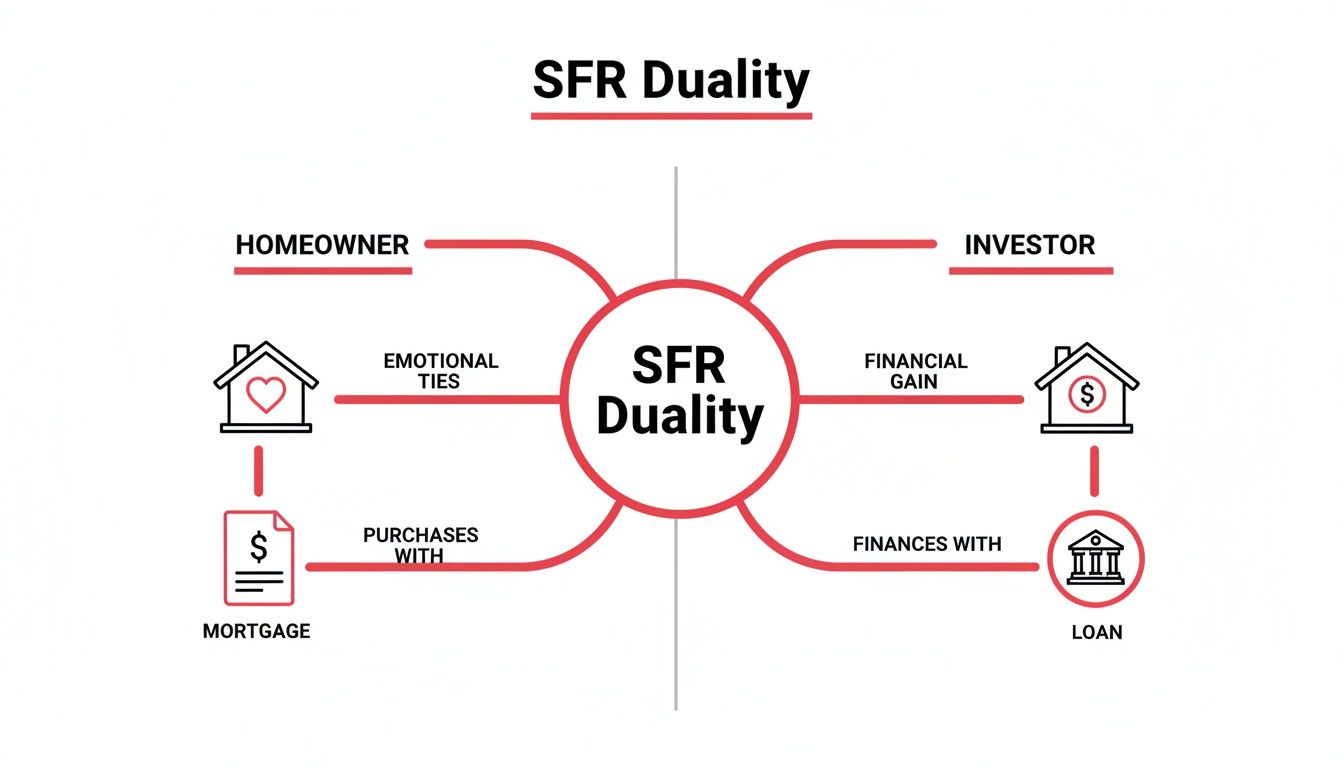
On one side, you have the emotional connection of a homeowner; on the other, the bottom-line focus of an investor. It’s this blend that makes the SFR market so unique.
Freedom vs. Convenience: The SFR and Condo Trade-Off
The biggest selling point for an SFR is pure autonomy. As the owner, you call all the shots. You get to decide on the paint color, the landscaping, and every upgrade inside. No shared walls also means more privacy for your tenants, which is a huge draw that often translates into longer tenancies and happier renters.
Condos, on the other hand, offer convenience but sacrifice control. The Homeowners Association (HOA) takes care of the big-ticket maintenance like replacing the roof or landscaping the common areas, which can be a massive weight off your shoulders. But that convenience comes with a rulebook and monthly fees. The HOA can dictate everything from your pet policy to whether you're even allowed to rent your unit out on a short-term basis.
Scalability vs. Simplicity: Multifamily and SFRs
If your goal is to grow your portfolio quickly, multifamily properties like duplexes or small apartment buildings are built for scalability. Buying one four-unit building gives you four streams of income under a single roof. This streamlines management and can seriously boost your returns. Plus, if one unit sits empty for a month, you still have rent coming in from the others.
But managing a multifamily property is a different animal entirely. The upfront investment is significantly higher, getting financing is often more complicated, and managing multiple tenants can feel like a full-time job.
An SFR offers a much simpler, more direct entry into real estate investing. You’re managing one property, one lease, and one family’s needs. It’s a focused, personal way to build your portfolio.
Ultimately, there’s no single "best" option. It all comes down to your personal goals. Are you after maximum control (SFR), hands-off maintenance (condo), or rapid, scalable income (multifamily)? Each path offers its own distinct set of challenges and rewards.
Why Investors Love Single-Family Rentals
So, what’s the big deal with single-family rentals? It seems like everyone from first-time investors to massive Wall Street firms is snapping them up. For me, the appeal really comes down to a few core advantages that make them a uniquely powerful asset.
For starters, there's a different kind of tenant dynamic. People renting a whole house tend to settle in and treat it like their own. They mow the lawn, get to know the neighbors, and often stay for years. This "pride of rentership" means less wear and tear on your property and fewer costly vacancies.
You also get a level of control that you just don't find in other types of rentals. No condo board or HOA is telling you what color you can paint the shutters. If you want to build a deck to increase the property’s appeal and rental rate, you just do it. That freedom is a huge plus.
A Tangible and Appreciating Asset
Beyond the monthly rent check, you're holding a tangible asset that historically appreciates in value. You’re not just collecting cash flow; you're building real, long-term wealth as the property itself becomes more valuable over time.
For many, an SFR isn't just a number on a spreadsheet. It's a real home in a real neighborhood, making it a more personal and understandable investment compared to complex commercial properties.
The demand is also incredibly strong and only getting stronger. The U.S. has over 85 million renter households, and SFRs now represent a growing 40% slice of the rental market.
Think about this: in 2023, the vacancy rate for single-family rentals dropped to a historic low of just 4.9%. For comparison, apartments had a vacancy rate of 6.5%. That difference tells a clear story about where the demand is headed.
Those low vacancy numbers are a green light for investors, signaling consistent rental income and less risk. It’s a similar supply-and-demand dynamic that drives short-term rental occupancy rates, proving that having the right property in the right market is key.
Making Your SFR Listing Impossible to Ignore

What makes your single-family rental special? It’s the unique character—that cozy fireplace, the big backyard, or the charming kitchen. But if your listing photos are dark and blurry, you’ve essentially prepared a five-star meal and served it on a paper towel.
This is where professional photo editing makes a world of difference. It’s not about faking it; it's about capturing the genuine feeling of the space so potential renters can imagine themselves living there before they even step inside.
Showcasing Your SFR’s True Value
Think of your listing photos as your digital handshake. They’re the first impression and, frankly, the most powerful tool you have for building trust and sparking a connection with a prospective tenant.
For Airbnb hosts and serviced apartment operators, visuals are absolutely everything. It’s a proven fact: professionally edited photos can boost click-through rates by 40% and bookings by a whopping 35%. Data from Zillow even shows that listings with high-quality photos rent 32% faster.
A small investment in great images isn’t just an expense. It's a strategic move to shorten vacancy periods and attract higher-quality applicants who appreciate the care you’ve put into your property.
Services like rental.photos can turn around human-reviewed, AI-enhanced photos in under 24 hours. This blend of smart technology and a human touch ensures your pictures look inviting and authentic, not fake or overprocessed. Our detailed guide on pictures for real estate marketing has even more tips for creating a standout listing.
At the end of the day, your goal is to make your listing the one they can’t stop thinking about. Professional visuals are how you tell your property's story and make that happen.
Common Questions About SFR Investing
Jumping into single-family rentals for the first time brings up a ton of questions. I remember when I was starting out—my head was spinning with all the "what ifs" and "how-to's." To help you cut through the confusion, here are some straight-up answers to the questions I hear most often.
My goal is to give you the practical, no-fluff info you need to take your next step with confidence.
Is Getting a Loan for an SFR Investment Property Harder?
It's different, but not necessarily harder. When you're buying an investment property, lenders look at it as a business deal. That means they usually want a bigger down payment, typically around 20-25%. Your interest rate might also be a touch higher than the one on your primary home.
But here's the upside: the bank will factor in the property's potential rental income when they review your application. This can seriously boost your chances of getting approved. The trick is to work with a lender who actually understands real estate investing.
Think of it like this: for your own home, lenders are betting on you. For an investment property, they're betting on the house itself to make money. It’s a shift from a personal bet to a business one.
What Are the Biggest Day-to-Day Challenges of Owning an SFR?
The very thing that makes SFRs so great—total control—is also their biggest challenge. You're responsible for everything.
When a pipe bursts at 2 AM or the AC dies in the middle of a heatwave, that's your problem to solve. You either need a go-to list of reliable handymen and contractors or be ready to get your own hands dirty. If you're running it as a short-term rental, you're also the hospitality manager, dealing with cleanings, restocking supplies, and answering guest messages at all hours. You get the final say, but you also carry the final weight.
Can I Turn Any House into an Airbnb or Short-Term Rental?
Definitely not. This is probably the single biggest tripwire for new investors. Cities, counties, and especially Homeowners Associations (HOAs) can have incredibly strict rules about short-term rentals. Some places ban them completely, while others require expensive permits, inspections, and limit how many nights you can rent it out per year.
Before you even dream of buying an SFR for a vacation rental, you have to do your homework on the local regulations. It's also smart to think about how you'll stand out from the competition—for instance, our guide on floor plans and photography shows how great visuals can make your listing more attractive while still following the rules. Skipping this research phase is a fast track to hefty fines and a dead-end investment.
Ready to make your SFR listing the one everyone wants to book? At rental.photos, we use a blend of smart AI and expert human review to deliver stunning, high-quality images in under 24 hours. Elevate your listing and turn more views into bookings at https://rental.photos.
Ready to have professional photos?
Our team transforms your existing rental photos into stunning, high-converting images that bring you more bookings. No photoshoot required. 100% refund guaranteed.
Improve My Photos →