A Host's Guide to Short Term Rental Occupancy Rates
Let's be real—your short-term rental occupancy rate is the true pulse of your business. In simple terms, it’s just a percentage that shows you how many nights your place was booked by happy guests compared to all the nights it was available.
Getting a handle on this number was the first step I ever took in moving from anxious guesswork to a confident, data-backed hosting strategy. It can be for you, too.
Why Your Occupancy Rate Is More Than Just a Number
If you're a host, you've probably asked yourself one question more than any other: "How do I get more bookings?" I used to obsess over this. The key to finally answering that question is often found by digging into your occupancy rate.
This single metric is so powerful because it gives you a clear, honest snapshot of how your property is really performing. It’s not just about filling empty nights; it's about building a sustainable, profitable business that you can actually rely on.
Understanding your occupancy rate helps you shift from hoping for bookings to actively creating a plan that attracts them. It’s the difference between reacting to a dreaded empty calendar and proactively managing your rental for a much healthier bottom line. For any host serious about success, this is where a solid strategy begins. You can learn more about how to get more Airbnb bookings in our detailed guide.
What This Guide Will Cover
This guide is built to give you the practical tools and knowledge to take control of your booking calendar. We’ll break down several key areas to help you keep your property consistently filled:
- Calculation and Benchmarks: We'll start with the simple formula to figure out your occupancy rate and, just as importantly, what a “good” number actually looks like for your specific market.
- Seasonal Trends: You'll learn how seasons, holidays, and local events affect your bookings and how you can create a smart plan to navigate those peaks and valleys.
- Key Booking Factors: We’ll explore the four pillars that truly drive success—pricing, listing quality, guest experience, and marketing.
- Actionable Strategies: You'll get practical, proven tips and quick wins that you can put into action today to start seeing a real difference.
By the end of this guide, you won't just know what your short term rental occupancy rate is; you'll know exactly how to improve it. Think of this as your personal roadmap from an unpredictable schedule to a consistently booked property.
What Is an Occupancy Rate and How Do You Calculate It?
Let’s get right to it. Your short-term rental occupancy rate is one of the most critical numbers you need to track. But don't worry, it's not complicated. Think of it as your property's pulse—it tells you exactly how healthy your booking activity is.
Simply put, it’s the percentage of nights your place was booked compared to the total number of nights it was actually available to guests. This single metric cuts through the noise and shows you, at a glance, how well your rental is performing. It’s the first step to making smarter, more profitable decisions.
This chart shows why moving from guesswork to a data-backed strategy is the key to a full calendar and a healthy bottom line.
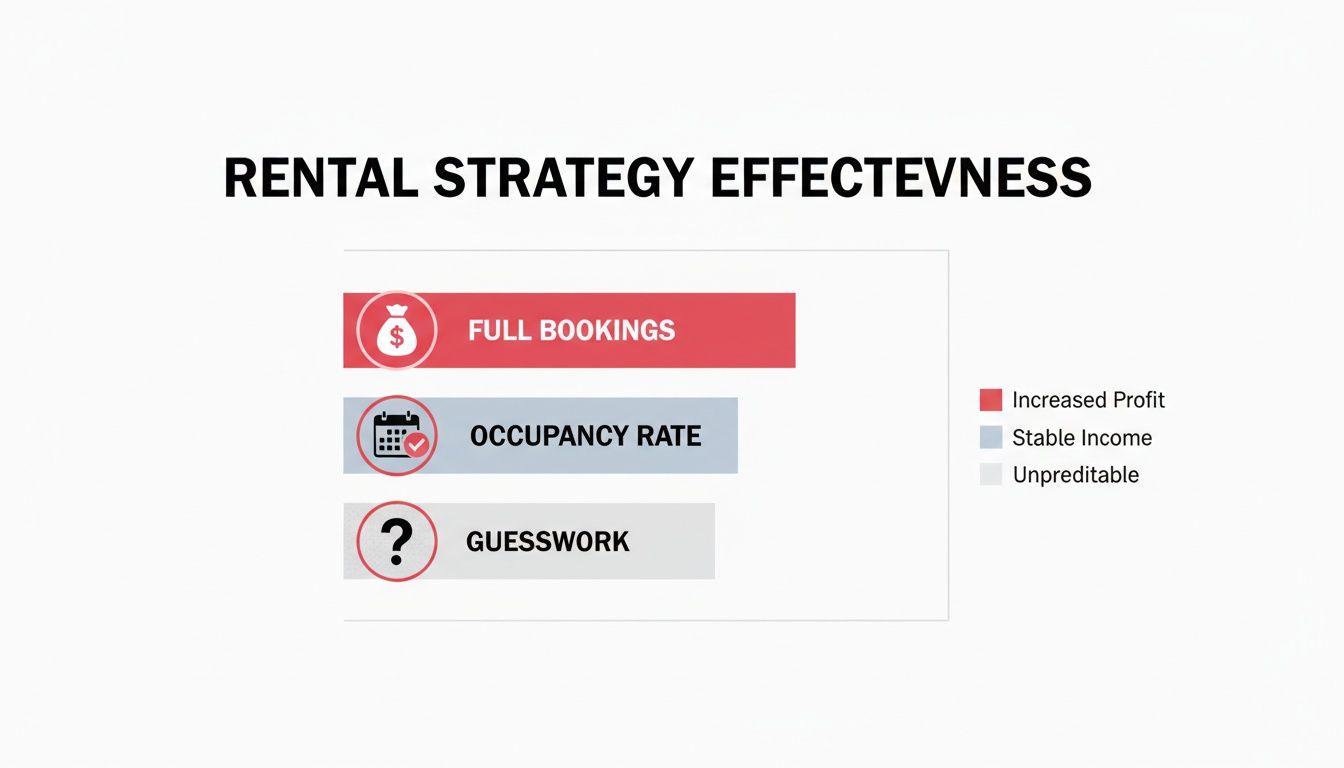
As you can see, just hoping for bookings is a recipe for unpredictability. Focusing on your occupancy rate, on the other hand, helps you build a stable business that maximizes both bookings and revenue.
The Basic Formula for Occupancy Rate
At its heart, the calculation is incredibly simple. All you need are two numbers: how many nights guests booked and how many nights your property was available to be booked over a certain period.
Occupancy Rate = (Number of Booked Nights / Total Available Nights) x 100
This formula spits out a percentage. For example, if your mountain cabin was available for all 31 days in October and you booked 25 of them, your occupancy rate for the month would be a solid 80.6%.
A Real-World Calculation Example
Let's walk through it with a quick example. Imagine you're Sarah, and you own a cozy beachside cottage.
- Pick a Time Frame: Sarah wants to see how she did in July. July has 31 days.
- Count Available Nights: She blocked off one night for some quick maintenance. That means her cottage was only available for 30 nights (31 total days minus 1 blocked night).
- Count Booked Nights: A quick look at her calendar shows guests stayed for a total of 25 nights in July.
Now, just plug those numbers into the formula:
- (25 Booked Nights / 30 Available Nights) x 100 = 83.3%
Sarah’s occupancy rate for July was 83.3%. Now she has a real number she can use to compare against last July, last month, or even what her competitors are doing down the street.
What Is a Good Occupancy Rate?
So, what number should you be aiming for? The honest-to-goodness answer is: it completely depends on your market. A "good" occupancy rate for a condo in a bustling city like Miami is a world away from a seasonal ski chalet in Vermont.
There's no single magic number that works for everyone. However, it's helpful to have a general idea of what to expect in different types of locations.
The table below gives you a feel for what constitutes a 'Good', 'Average', or 'Low' occupancy rate across a few common market types.
Occupancy Rate Benchmarks by Market Type
| Market Type | Good Occupancy Rate | Average Occupancy Rate | Low Occupancy Rate |
|---|---|---|---|
| Bustling Urban City | 75% - 90% | 60% - 74% | Below 60% |
| Seasonal Beach Town | 80% - 95% (Peak) | 40% - 60% (Annual) | Below 30% (Off-Season) |
| Mountain/Ski Resort | 85% - 95% (Peak) | 45% - 65% (Annual) | Below 35% (Off-Season) |
| Rural/Nature Retreat | 65% - 80% | 50% - 64% | Below 50% |
This table provides much-needed context. It helps you set realistic goals and shows that a 55% annual rate for a beach house might actually be fantastic once you factor in those slow winter months. The real key is to benchmark your performance against similar properties in your specific area.
Why Your Bookings Change with Seasons and Events
Ever stare at your booking calendar and wonder why it’s jam-packed in July but a total ghost town come February? I've been there. That's seasonality in a nutshell. It’s the single biggest factor influencing your short term rental occupancy rates, driven by the natural rhythm of weather, holidays, and just plain human behavior.
Think of it this way: a cabin near a ski resort is a hot commodity from December to March. A beachfront cottage, on the other hand, practically sells itself during the summer. Every property has its own rhythm, and learning to anticipate these peaks and valleys is the first real step to becoming a proactive host.
Instead of getting blindsided by a slow month, you can start to see it coming. When you understand your market's seasonality, you're no longer just reacting to your booking calendar; you're conducting it. This foresight is powerful, letting you tweak your strategy and turn those quiet periods into real opportunities.
Riding the Waves of Demand
The best hosts don't fight the market's current; they learn to ride the waves. This means looking beyond the four seasons and tuning into the specific pulse of your local area.
What brings people to your town? Nailing this down is everything.
- Seasonal Peaks: This is the obvious one. Is it summer vacation, ski season, or the autumn colors that draw a crowd?
- Holidays and Long Weekends: Never, ever underestimate the power of a three-day weekend. Memorial Day, Labor Day, and Thanksgiving can create their own mini-peak seasons.
- School Breaks: Spring Break and summer vacation unleash a massive wave of travel from families and students. Knowing the local and regional school schedules gives you a serious leg up.
By mapping out these predictable periods, you can prep your marketing, adjust your pricing, and make sure your listing is shouting about the right features at the right time. Promoting your "cozy fireplace" in October makes a lot more sense than in June.
The Power of Local Events
Beyond the broader seasonal trends, big local events are like magnets for travelers. They create short, intense bursts of demand that can supercharge your occupancy rate almost overnight. We're not talking about small bumps in bookings; these are tidal waves of opportunity.
Think about music festivals like Coachella, major sporting events like the Super Bowl, or huge conferences. For a few days or a week, these events can turn an average market into one of the most in-demand destinations in the country. This is where a smart host can really clean up.
Major events are already driving huge spikes in short-term rental occupancy for host cities. Look at the Milan Winter Olympics: 100 days out, occupancy shot up from ~3% last year to 21%—an 18-point jump as people book early. It's the same story for the Super Bowl in Santa Clara, where occupancy leaped from ~2% to ~15% at the same point. You can dig into more of this data with these short-term rental trend insights from Pricelabs.co.
This data proves that knowing what’s happening in your city isn’t optional. I keep a calendar of major local events, and you should too. It will let you see these spikes coming, adjust your nightly rates, and market your property to the right crowd so you don't miss out on a golden opportunity to fill your calendar.
The Four Pillars That Control Your Bookings
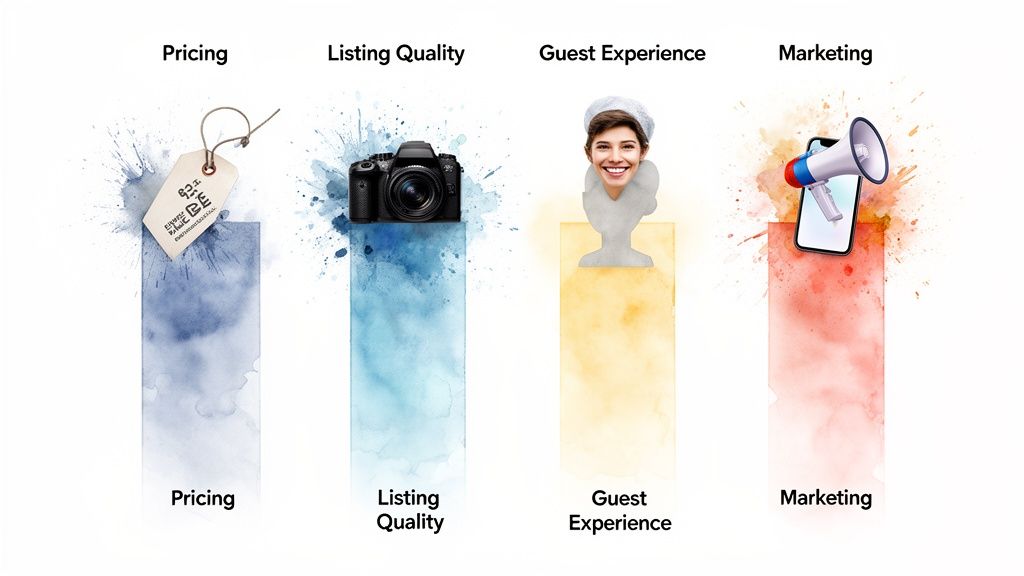
Knowing the numbers and seasonal trends is a massive step forward, but what actually gets people to book your rental? It’s never just one thing. In my experience, it's a combination of four core elements working in harmony to turn a casual browser into a paying guest.
Think of it like building a house. You need four strong walls to hold up the roof. If one is weak, the whole structure feels shaky. But when all four are solid, you create a business that can weather any storm. These pillars are your pricing, the quality of your listing, the guest experience you deliver, and your marketing.
Let's dig into each one and see how you can strengthen them.
Pillar 1: Your Pricing Strategy
Pricing isn't just about slapping a number on a night. It's a powerful signal to potential guests about the value you offer, and it's your primary tool for adapting to a market that changes by the day. Price too high, and you'll scare people away. Price too low, and you leave money on the table while potentially attracting the wrong kind of guest. I learned that one the hard way.
The goal is to find that sweet spot—a price that feels like a bargain to your guests but still maximizes your profit. To do that, you have to think dynamically. Your rate for a rainy Tuesday in February shouldn't be the same as a sun-drenched holiday weekend.
This is where dynamic pricing tools like PriceLabs or Wheelhouse become invaluable. These services chew through real-time market data—local events, flight demand, competitor rates—and adjust your prices automatically. It takes the guesswork out of the equation and ensures you're earning the most for every single night.
Pillar 2: Your Listing Quality
Your listing on Airbnb, Vrbo, or Booking.com is your digital storefront. It's the first—and often only—impression you get to make. In a crowded market, you have just seconds to grab a potential guest's attention and earn their trust.
A polished, professional listing is built on two key components:
- Compelling Descriptions: Don't just list amenities; tell a story. Who is your perfect guest? What unique experience can they have at your place? Instead of "patio with grill," try "a backyard built for sunset barbecues." Instead of "chair by window," try "the perfect sun-drenched nook for your morning coffee." Words create the vibe.
- Stunning Photography: This is the big one. Guests can’t walk through your property, so your photos have to do all the work. Dark, blurry, or uninspired shots are the fastest way to get scrolled past, no matter how amazing your rental actually is.
In today's visually-driven market, amazing photos are non-negotiable. Listings with professionally enhanced images that pop with cozy lighting and vibrant colors can boost bookings by up to 35%. For hosts needing a fast, affordable upgrade, services like rental.photos can deliver magazine-quality images in under 24 hours for just $49 per listing. This is critical, especially since last-minute reservations now account for 27% of all bookings, meaning guests are making faster decisions based on what they see.
Your photos aren't just pictures; they are your most powerful sales tool. They need to stop the scroll and make someone say, "I want to stay there." A small investment in high-quality images pays for itself with just one or two extra booked nights.
Pillar 3: The Guest Experience
The work isn't over when the booking comes in—it’s just beginning. The experience you provide from the moment they book until they check out is what fuels your long-term success. Why? Because happy guests leave glowing reviews.
And glowing reviews are pure gold. They are the social proof that screams, "This place is legit, and this host is great!" This creates a powerful cycle:
- An amazing stay leads to a 5-star review.
- More great reviews push your listing higher in search results.
- Higher rankings and trusted reviews lead to more bookings.
- More bookings give you more chances to create incredible experiences.
This is how you build a sustainable business. Nail the fundamentals: lightning-fast communication, a sparkling clean space, and thoughtful touches. A handwritten welcome note or a curated list of your favorite local spots can make all the difference. You can also elevate the guest experience before they even arrive by learning some tips on using floor plans and photos together.
Pillar 4: Your Marketing and Distribution
Finally, even the world's greatest rental won't get booked if no one sees it. While most hosts start on Airbnb, relying on a single platform is like fishing in only one part of a giant lake. To fill your calendar, you need to cast a wider net.
Listing your property on multiple platforms—known as multi-channel distribution—exposes you to a much bigger pool of potential guests. Make sure you're listed on:
- The Big Three: Airbnb, Vrbo, and Booking.com are non-negotiable. They have the largest audiences.
- Niche Sites: Depending on your rental, specialized sites for luxury stays, pet-friendly homes, or unique properties can connect you with highly motivated travelers.
- Social Media: Use Instagram or Facebook to create a brand for your property. Post stunning photos, share local tips, and run promotions to build a following and attract direct bookings.
Don't just copy and paste your listing everywhere. Each platform has its own algorithm and audience. Take the time to tweak your titles, descriptions, and photo order for each one. This extra effort will help you stand out and keep your short-term rental occupancy rates high.
Practical Strategies to Boost Your Occupancy Rate
Enough theory—let's get practical. Knowing your numbers is one thing, but turning that knowledge into a fuller calendar is where the real magic happens. Think of this as your personal toolkit for converting views into bookings and transforming those dreaded empty nights into revenue.
Let's dive into some actionable strategies you can implement right away to increase your short-term rental occupancy rate, starting with some quick, high-impact tasks.
Start with These Quick Wins
Sometimes, the smallest changes make the biggest difference. Before you overhaul your entire strategy, start with these simple but powerful tweaks that can deliver surprisingly fast results.
- Refresh Your Headline and Main Photo: Your title and primary image are your first impression. Try changing your headline to highlight a seasonal perk (like "Cozy Fireplace for Chilly Nights") and swap in a fresh, bright hero image that stops the scroll.
- Respond to Every Single Review: Taking the time to acknowledge reviews—both good and bad—shows potential guests you're an engaged and caring host. A simple "Thank you for staying with us!" can go a long way in building trust.
- Update Your Amenities List: Did you just add a new coffee maker or upgrade to faster Wi-Fi? Get it on the list! Small details are often the deciding factor when a guest is choosing between two similar properties.
- Tweak Your First Paragraph: Rewrite the first 50 words of your description to speak directly to your ideal guest. Hook them immediately by painting a picture of the exact experience they’re looking for.
Elevate the Experience with Advanced Strategies
Once you've nailed the basics, it's time to roll out strategies that truly set you apart from the competition. These tactics are all about enhancing the guest experience and attracting different types of travelers, especially during your slower periods.
Think beyond just providing a place to sleep. You're offering an experience.
A fantastic way I do this is by creating a compelling digital welcome guide. This isn't just a binder on the coffee table; it's a beautifully designed PDF you can send to guests the moment they book. Fill it with your personal recommendations for local coffee shops, hidden gems, and must-see attractions to make them feel like insiders from day one.
Another great strategy is to cater to longer stays. For any booking over a week, consider offering a complimentary mid-stay clean. This small gesture is a huge perk for guests, making their stay more comfortable and encouraging those longer, more profitable bookings. For more ideas, check out these essential Airbnb host tips for beginners.
Target Off-Season Travelers
A quiet calendar in the off-season doesn't have to be a given. With a slight shift in focus, you can attract guests who are actively looking for a peaceful getaway when everyone else is at home.
The key is to target specific traveler personas:
- Remote Workers: Be loud and proud about your lightning-fast Wi-Fi, dedicated workspace, and proximity to great coffee shops. Offer attractive weekly or monthly discounts to entice digital nomads.
- Staycationers: Market to locals in nearby cities who are itching for a change of scenery. Promote your space as the perfect weekend escape—no plane ticket required.
- Couples Seeking a Quiet Retreat: Emphasize cozy features like a fireplace, a bathtub, or a private balcony. Frame your property as the ideal spot for a romantic and relaxing getaway.
Remember, the off-season traveler isn't looking for a bustling tourist trap. They want peace, comfort, and value. Adjust your listing's story to speak directly to those needs.
Tell a Story with Your Photography
Let's be brutally honest: your photos are the single most important part of your listing. Guests can't tour your home in person, so your images are the tour. Dark, blurry, or uninviting snapshots will kill your occupancy rate faster than anything else.
Your photos need to do more than just show a room; they need to sell a dream. They need to scream, "Book me now!"
This is where professional photo enhancement becomes a host's secret weapon. Services like rental.photos transform mediocre phone pictures into bright, cozy, and professional images that capture a guest's imagination. Their process is dead simple: you upload your images, and in less than 24 hours, you get back a full set of polished photos ready to go.
What makes their service so effective is the blend of smart AI and a human touch. An intelligent model refines the lighting and color, but then a real editor reviews every single photo to ensure it looks natural and inviting. This crucial human oversight prevents that overly processed, artificial look some automated tools produce, ensuring your photos feel authentic and build trust.
The U.S. short-term rental market has seen occupancy stabilize in the high-50s percent range, but with more properties entering the market, competition is fierce. Guests are also booking closer to their travel dates, with last-minute bookings (made within 7 days) now making up 27% of all reservations. This trend means your listing has to convert impulse views fast. Professionally enhanced photos are a game-changer here; the rental.photos service can polish up to 30 images for just $49, helping to lift bookings by as much as 35%.
Investing in your photography isn't an expense; it's a high-return investment that pays for itself with just a few extra booked nights.
Answering Your Top Occupancy Rate Questions
After everything we've covered, a few key questions always seem to pop up when I'm chatting with other hosts. Let's tackle some of the most common ones I hear about short-term rental occupancy rates. My goal is to give you clear, straightforward answers to help you manage your rental with a lot more confidence.
Think of this as our final chat over coffee, where we clear up any lingering doubts.
What Is a Good Short Term Rental Occupancy Rate?
Honestly, there’s no single magic number. A “good” rate is all about context—your specific market, your property type, and the season you’re in. A 65% annual rate for a condo in a hyper-competitive city like Honolulu could be absolutely fantastic.
On the other hand, a seasonal mountain cabin might aim for 90% during peak ski season and be perfectly happy with 30% during the quiet months. The most important thing is to stop comparing your property to some vague national average.
The real key is to benchmark against similar properties in your direct area. Aiming for 10-15% above your local market's average is a solid, achievable goal. Tools like AirDNA or PriceLabs can help you find that local benchmark and set targets that actually make sense for you.
How Can I Increase My Occupancy During the Slow Season?
The slow season is where creative hosts really shine. Your first move should be to adjust your pricing dynamically; you simply have to be more competitive when demand is low.
Next, think about who travels in the off-season and market directly to them. This is the perfect time to target:
- Remote Workers: Offer weekly or monthly discounts and make sure to highlight your fast Wi-Fi and dedicated workspace.
- Locals on "Staycation": Promote your place as the perfect weekend escape for people living in nearby cities.
- Couples or Solo Travelers: Emphasize cozy, quiet amenities like a fireplace, a great reading nook, or a soaking tub.
Finally, use this downtime to invest in your listing. A quick photo refresh can make your property look appealing and inviting year-round, capturing the attention of guests searching for a peaceful getaway.
Does Lowering My Price Always Increase My Occupancy Rate?
Not always, and it can be a dangerous game to play. While a strategic, last-minute price drop can definitely fill an empty night, constantly being the cheapest option on the block is a race to the bottom. It often attracts less-than-ideal guests, which can lead to worse reviews and hurt your long-term occupancy.
A much better approach is to focus on value, not just price. Instead of slashing your rate by $20, try keeping the price and adding a welcome basket or offering flexible check-in. The goal isn't just a high occupancy rate; it's a high Revenue Per Available Night (RevPAR). Sometimes, a slightly lower occupancy at a higher nightly rate is far more profitable.
How Important Are Photos for My Occupancy Rate?
Let me be direct: your photos are the single most important factor in turning a casual browser into a confirmed guest. It's that simple.
Potential guests can't tour your property in person, so your photos create their entire first impression. Dark, blurry, or unappealing images will make them scroll right past your listing, no matter how great your price, location, or amenities are.
Investing in professional, high-quality images is one of the highest-return decisions you can make as a host. It's the visual handshake that builds trust and gets someone excited to book your space.
Ready to make your photos stop the scroll and turn views into bookings? With rental.photos, you can transform your existing images into stunning, professional-quality photos in under 24 hours. Our human-reviewed enhancement service ensures every picture looks bright, cozy, and irresistible. Elevate your listing and watch your calendar fill up by visiting https://rental.photos.
Ready to have professional photos?
Our team transforms your existing rental photos into stunning, high-converting images that bring you more bookings. No photoshoot required. 100% refund guaranteed.
Improve My Photos →