Master real estate twilight photography effortlessly
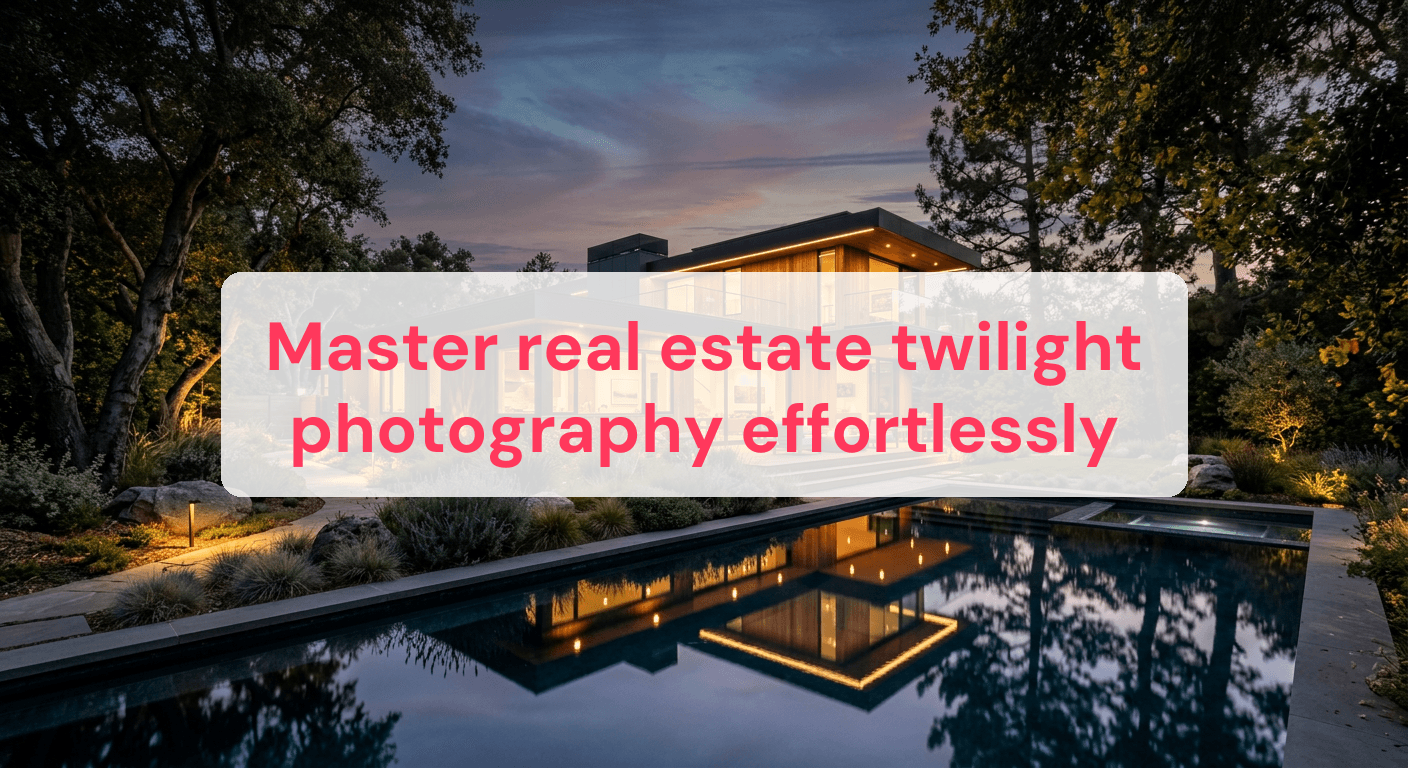
Did you know that properties showcased with twilight photography can see up to a 30% increase in booking rates? This striking technique transforms ordinary listings into captivating scenes, drawing potential guests in with the allure of a perfectly timed sunset. Twilight photography captures the magical moment between sunset and nightfall, where the sky exhibits a stunning gradient of colors and the property is illuminated just enough to highlight its features without harsh shadows. However, achieving this enchanting effect requires more than just clicking a shutter button at dusk. Through mastering specific techniques, including perfect timing and composition, you can significantly enhance your property's appeal. By the end of this guide, you'll know exactly how to harness the power of twilight photography to make your listings stand out and entice more bookings.
Capture the perfect twilight moment
Capturing the perfect twilight moment is crucial for creating captivating real estate photos that can enhance the visual appeal of your property listings. Timing is everything when it comes to twilight photography, as the window for capturing the ideal light is both brief and specific. The best time to photograph your property is typically 20-30 minutes after sunset, during the so-called "blue hour." This is when the sky takes on a deep, rich hue that contrasts beautifully with the warm lights of the property, creating a balanced and inviting scene.
Why timing matters in twilight shots
Understanding the importance of timing is key to mastering twilight photography. The period just after sunset offers a unique blend of natural light and darkness that can make your property stand out. Missing this window can result in either overly bright photos or images that are too dark to show off the property's features effectively.
Consider a scenario where you are photographing a beachfront property. As the sun dips below the horizon, the sky begins to transition through shades of orange, pink, and eventually a deep blue. Shooting during this time allows you to capture the vibrant colors that reflect off the water, enhancing the property's natural beauty. The subtle lighting can also highlight architectural features like large windows or unique rooflines, which might get lost in harsh daylight or complete darkness.
Real-world example: Enhancing warmth and allure
Imagine photographing a cozy mountain cabin. By timing your shots 20 minutes post-sunset, you can emphasize the warmth emanating from the cabin's interior lights. This creates an inviting glow that contrasts with the cool, twilight sky, making the cabin appear as a welcoming retreat. The surrounding trees and landscape are softly illuminated, adding depth and dimension to the photo. Such well-timed images can evoke a sense of comfort and tranquility, drawing potential guests in with the promise of a peaceful getaway.
For more detailed tips on elevating your property images, you might find our Real Estate Photo Techniques guide helpful.
Optimize your camera settings for low light
Capturing the perfect twilight shot requires an understanding of how to adjust your camera settings to handle low-light conditions effectively. The goal is to maintain clarity and detail without introducing noise or blur. Here's how you can set up your camera to maximize your twilight photography results.
Adjusting ISO, Shutter Speed, and Aperture
-
Set Your ISO: Begin by setting your ISO to a low number, such as 100 or 200, to reduce noise. While higher ISO settings can compensate for low light, they often introduce graininess, which can detract from image quality.
-
Control Your Shutter Speed: Use a slower shutter speed to allow more light into the camera. A setting like 1/60 second can be a starting point. Keep in mind, however, that slower shutter speeds may require a tripod to avoid camera shake.
-
Aperture Settings: Opt for a wide aperture, such as f/2.8 or f/4, to let in more light. This also creates a shallow depth of field, which can enhance the focal point of your image.
-
Use a Tripod: A sturdy tripod is essential in twilight photography to prevent blurry images, especially when using slower shutter speeds. It ensures stability and allows for longer exposures without the risk of camera shake.
Common mistakes with twilight settings
-
Over-reliance on High ISO: While increasing ISO can seem like a quick fix for low light, it can lead to excessive noise. Aim to keep ISO as low as possible and use alternative methods like slower shutter speeds.
-
Ignoring White Balance: Twilight conditions can trick your camera's white balance settings, resulting in color casts. Set your white balance manually to maintain accurate colors.
-
Neglecting Manual Focus: Autofocus can struggle in low-light conditions. Switch to manual focus to ensure sharpness in critical areas of your composition.
By fine-tuning your camera settings and employing a few strategic techniques, you can capture stunning twilight images that highlight the unique features of your property. For more insights, explore our Real Estate Photo Tips to further enhance your photography skills.

Leverage natural and artificial lighting
Successfully balancing natural twilight with artificial lighting can dramatically enhance your property's allure. As twilight casts a soft, magical light, it serves as an ideal backdrop to showcase both interior and exterior features. To achieve this balance, consider the following strategies:
Creating ambient lighting effects
Ambient lighting sets the mood and enhances the property's appeal, especially during twilight. Here are some practical ways to create ambient effects:
-
Exterior Lights: Use pathway lights and porch lights to highlight architectural features and guide the viewer's eye. For example, soft uplighting can accentuate columns or textured walls, creating depth and intrigue.
-
Interior Lighting: Illuminate key areas like the living room and kitchen to convey warmth and hospitality. Consider using dimmable lights to control the intensity and create a cozy atmosphere.
-
Landscape Illumination: Garden lights or strategically placed spotlights can highlight trees and shrubs, adding layers to the composition. This not only enhances the photo but also suggests a well-maintained property.
Real-world impact of lighting balance
In real-world scenarios, lighting can transform an image's mood. For instance, a well-lit pool area against a twilight sky can evoke a sense of luxury and relaxation. Alternatively, illuminating a patio with string lights can suggest an inviting space perfect for evening gatherings. 90% of potential renters report that photos play a crucial role in their decision-making, so capturing these lighting effects can significantly impact bookings.
By thoughtfully combining natural and artificial lighting, you can create stunning twilight images that capture the essence of your property and entice potential guests. For more detailed strategies, explore our Vacation Rental Photo Tips.
Enhance composition to highlight property features
Emphasizing architectural details
When photographing your rental property during twilight, the way you compose your shots can dramatically influence their impact. Symmetry is a powerful technique you can use to create a sense of balance and order. Position yourself directly in front of the property to capture a symmetrical view, showcasing the grandeur of architectural elements like columns, windows, or entryways. For example, if your property features a prominent front door flanked by large windows, centering these elements in your shot can create a visually appealing composition.
Leading lines can also guide the viewer’s eye through the photo, highlighting features you want to emphasize. Consider using pathways, fences, or even the alignment of trees to draw attention to key areas of your property. For instance, a curving driveway leading up to the entrance can act as a natural guide, leading viewers' eyes right to the front door.
Avoiding cluttered compositions
A cluttered composition can detract from your property's best features. To maintain focus, ensure that each element in your photo serves a purpose. Remove unnecessary items such as trash bins, garden tools, or excess outdoor furniture. These elements can distract from the architectural beauty of your property.
Consider using the rule of thirds to create balanced and dynamic compositions. Divide your image into nine equal parts using two equally spaced horizontal lines and two equally spaced vertical lines. Positioning important elements along these lines or at their intersections can add interest and guide the viewer's eye through the photo.
For more detailed strategies on composing your shots, explore our Real Estate Photo Composition Tips. By thoughtfully organizing your compositions, you can emphasize the unique features of your property and create images that captivate potential guests.
Edit your twilight photos for maximum impact
Editing your twilight photos is crucial to ensure they captivate potential guests and highlight the best features of your property. The right post-processing techniques can transform a good image into a stunning visual that attracts more views and bookings.
Editing to balance colors and contrast
Balancing colors and contrast is essential in twilight photography. The transition from day to night creates a unique blend of natural and artificial lighting that can be challenging to capture accurately. Here are some tips:
- Adjust the white balance to ensure the colors in your photo appear natural. Twilight often introduces a blue tint, so warming up the image slightly can help.
- Enhance contrast to bring out the details in both the shadows and highlights. This can add depth and dimension to your images.
- Boost saturation carefully to make colors pop without losing realism. Aim for a vibrant but not over-saturated look, which can detract from the image's natural beauty.
Utilizing editing tools effectively
Several editing tools are available to help you enhance your twilight photos. Familiarize yourself with these options to make the most out of your images:
- Adobe Lightroom: Ideal for global adjustments like exposure and color correction.
- Photoshop: Offers advanced features for more detailed edits and retouching.
- Luminar AI: Known for its AI-powered tools that simplify complex editing processes.
By mastering these tools, you can ensure your twilight photos are polished and professional. For more insights on enhancing your real estate photography, check out our Real Estate Photography Tips.
Remember, the key to successful twilight photography editing is to maintain a balance between enhancing the image and preserving its natural allure. With practice and attention to detail, your twilight photos can become powerful assets in showcasing your property's charm.
Capturing the essence of a property during different times of the day requires an understanding of how to adjust your camera settings according to the available light. Daylight and twilight present unique challenges and opportunities for photography, necessitating different approaches to camera settings. Below is a comparison of camera settings that can guide you in achieving the best results for both daylight and twilight photography.
| Setting | Daylight Photography | Twilight Photography |
|---|---|---|
| ISO | 100-200 (low sensitivity) | 400-800 (higher sensitivity) |
| Shutter Speed | 1/125 to 1/500 seconds | 1 to 4 seconds |
| Aperture | f/8 to f/16 (greater depth of field) | f/2.8 to f/5.6 (shallow depth of field) |
| White Balance | Daylight (5000-6500K) | Tungsten/Incandescent (3000-4000K) |
This table outlines key differences in camera settings to consider when transitioning from daylight to twilight photography. Adjusting ISO, shutter speed, aperture, and white balance appropriately can significantly impact the quality of your images, capturing the property's features in the best possible light.
Common Questions
Do I really need a wide-angle lens for real estate twilight photography?
A wide-angle lens is highly recommended for real estate twilight photography as it allows you to capture more of the property in a single frame. This is particularly useful when showcasing spacious interiors or expansive exteriors. Lenses with focal lengths of 16-35mm are popular choices for capturing both interior and exterior shots effectively.
Can I shoot twilight photos with a smartphone?
Yes, you can shoot twilight photos with a smartphone, although results may vary based on the device's capabilities. Modern smartphones with manual mode options allow you to adjust settings like ISO and shutter speed, which can be beneficial in low-light conditions. However, using a tripod is advisable to reduce camera shake during longer exposures.
What if the weather is overcast during twilight?
Overcast weather can still produce stunning twilight photos by offering a more diffused and even lighting condition. In such scenarios, focus on capturing the property's features that benefit from soft lighting, and consider using artificial lighting to highlight specific areas. Adjust your camera settings to compensate for the lower natural light to ensure well-exposed images.
How do I deal with reflections in windows during twilight photography?
To minimize reflections in windows, try shooting at an angle and using a polarizing filter, which can help reduce glare and reflections. Alternatively, adjusting the position of interior lights can also reduce unwanted reflections. If reflections are still an issue, consider addressing them during the post-processing stage by using editing software to enhance or remove them.
Mastering real estate twilight photography requires a keen understanding of timing, lighting, and composition. By capturing your photos during the optimal twilight window, you ensure a captivating blend of natural and ambient light that highlights your property's best features. Tailoring your camera settings to low-light conditions and enhancing your composition can transform ordinary shots into extraordinary ones. Finally, thoughtful post-processing will help balance colors and enhance the overall impact, making your twilight images truly stand out.
Ready to have professional photos?
Our team transforms your existing rental photos into stunning, high-converting images that bring you more bookings. No photoshoot required. 100% refund guaranteed.
Improve My Photos →